Moving to Berlin means learning a lot at once: a new city, new paperwork, new routines. Finding a therapist is rarely at the top of the list, until a hard week arrives and you realise you would like to talk to someone. If your German is still a work in progress, or if English is simply the language you think and feel in, looking for an English-speaking therapist in Berlin is a sensible place to begin.
Below, you will find why language matters in therapy, what to look at on a therapist’s profile, how in-person and online sessions differ, and which questions to ask in a first conversation.
Why the language of therapy matters
Therapy asks you to describe things that are often vague, private or hard to put into words: a tightness in your chest before a meeting, an old family argument, a worry that keeps you awake at night. Doing that in a second language is possible, and many people do it, but it adds a layer of effort. You may find yourself hunting for the right word, simplifying what you meant to say, or translating in your head while the therapist waits.
When you speak in the language you are most at ease with, more of your attention can go to what you are actually trying to express. That is why some people in Berlin look for a therapist who works in English from the start, rather than treating language as a detail to sort out later.
Where to start your search
The simplest route is a page that already groups therapists by city and language. At My International Therapy, the English-speaking therapists in Berlin are gathered on one page, and the therapists in the network are recruited, interviewed and selected by My International Therapy’s team of mental health professionals. Each profile states the languages offered, the therapies practised, and whether sessions take place in person, online, or both.
If you would rather see everyone and narrow things down yourself, the Berlin therapist directory lets you filter by therapy, speciality or language. And if you are not sure what to filter for, the short questionnaire Size uygun terapisti bulun helps you narrow down the therapists who match your needs. It shows how many therapists match at each step, and your answers are not sent or stored: they remain in your browser.
What to look at on a therapist’s profile
A profile tells you more than it first seems to. Here is what is worth reading, in roughly this order.
Languages
Check that English is listed, and notice what else appears next to it. Some therapists offer several languages, which can be useful if you are bilingual, if your partner speaks another language, or if you may want to switch later. English also means different things for different people: for some therapists it is a mother tongue, for others a language they have worked in for years. Either can be a good fit. What matters is that you feel understood, and a first session will tell you a lot.
Approach and areas of work
Profiles list the therapies a therapist practises and the areas they work in. You do not need to recognise every term.
Format and location
Some therapists meet clients in person in Berlin, some work online only, and some offer both. Read this line before you settle on a profile; it saves a disappointing message later.
In person or online?
Both formats have their place, and what suits you may change over time.
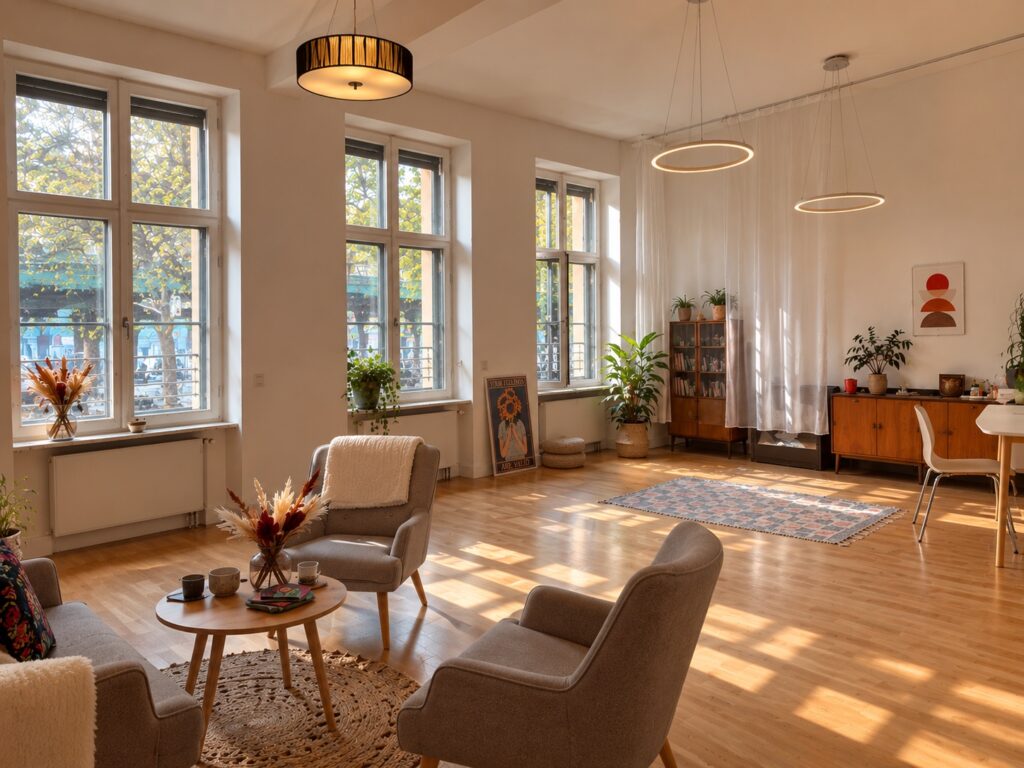
- In person. Some of our therapists meet clients at our centre in Berlin, at Schönhauser Allee 55 in Prenzlauer Berg. A dedicated space away from home can help you separate therapy from the rest of your day, and some people simply prefer sharing a room.
- Online. Video sessions remove the journey across town and can be easier to fit into a packed week. They also widen your choice: the therapist whose profile fits you best may not be the one closest to your flat.
If you are unsure, think about your week. Where could you realistically find an hour of privacy? Would crossing the city feel like a relief or an obstacle? Your honest answer is a good guide.
Questions worth asking in a first conversation
You are allowed to ask questions before committing to anything. A few that tend to be useful:
- Which languages do you work in, and which one feels most natural to you in sessions?
- Have you worked with people who have moved to Germany from abroad?
- How do your sessions usually work, and how often do you suggest meeting at the start?
- What are the practical details: session length, scheduling and cancellations?
- How will we review together whether the work suits me?
A good therapist will not mind these questions. How they answer is part of the information you are collecting.
A word on cost and insurance
Costs and reimbursement depend on the type of professional, your insurance and your own situation. Before you book, ask the therapist about fees and check with your insurer (public or private) what applies to you: whether a given session is covered depends on the insurer’s decision and on conditions that vary.
Sık sorulan sorular
How do I find an English-speaking therapist in Berlin?
Start with the English-speaking therapists page, which gathers the Berlin therapists who work in English. Open the profiles that appeal to you to read about each therapist’s languages, therapies, areas of work and whether they see clients in person, online or both. If you would like more guidance, the matching questionnaire can help you narrow things down.
Can I have sessions online with an English-speaking therapist?
Yes, some of our therapists work online. Each profile says whether sessions are in person, online or both, so you can pick the format that suits you. If you live outside Germany, check with the therapist first whether online sessions are possible in your situation.
Do I need to speak German to see a therapist in Berlin?
Not if the therapist’s profile lists English. The English-speaking therapists page and the language filter in the Berlin therapist directory help you see only the therapists who work in English, and you can confirm with the therapist which language you would like to use for the sessions.
What if I am not sure which kind of therapy I need?
That is very common. A first conversation with a therapist can help you work out what you are looking for, and a doctor or licensed health professional can also help you think about which kind of support suits you.
Is it normal to try more than one therapist?
Yes. Fit matters, and it can take some time to know whether you feel comfortable. If it does not feel right, you are free to look again.
Reaching out for support in a new city takes some courage, so give yourself credit for taking the first step. Whenever you are ready, the profiles are there to browse at your own pace.
Important. This article is general information. It is not a diagnosis, medical advice or a substitute for care from a qualified health professional, and it cannot assess your personal situation. If you are worried about your health, speak to a doctor or a licensed therapist. My International Therapy does not provide emergency or crisis care.
If you are in crisis or in immediate danger, call 112 (the free European emergency number). Free helplines, open day and night: Germany, Telefonseelsorge 0800 111 0 111 veya 0800 111 0 222; France, 3114; Spain, 024. More numbers: help in a crisis.